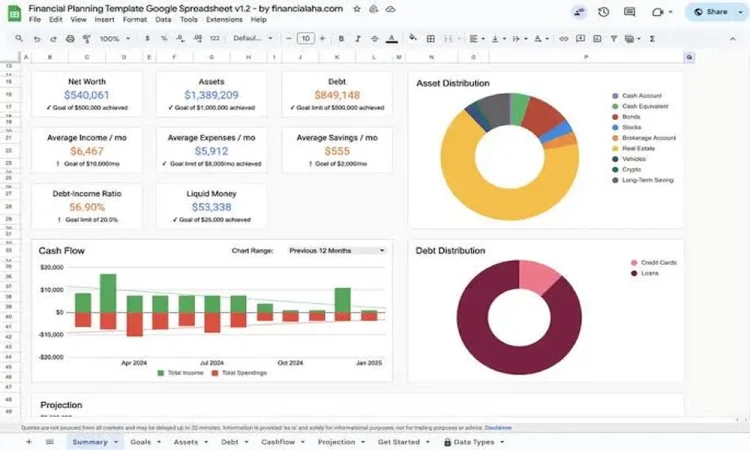
Tracking what you own and what you owe is one of the simplest ways to see whether your finances are moving in the right direction. The hard part is picking a spreadsheet that fits your life. Klarmo’s guide to 100 free Excel and Google Sheets templates shows how wide the choice is, from one page worksheets to full dashboards. This guide explains how to narrow that list down and start with confidence.
Start With Your Own Complexity Level
Klarmo groups its 100 templates by how far they take you. The split shows most people need less than they think:
- Basic (36 templates): A single snapshot of assets and liabilities with an automatic net worth total. Good for a first look at your position.
- Intermediate (44 templates): Monthly or yearly columns, charts and trend lines, so you can see change over time.
- Advanced (15 templates): Asset allocation, rebalancing, savings rate and financial independence metrics.
- Power user (5 templates): Live prices, transactions, tax treatment and multiple scenarios in one workbook.
If you have never measured your net worth, start at Basic or Intermediate. You can move up once the habit sticks.
Pick the File Type You Will Actually Open
The best template is the one you update regularly. In Klarmo’s collection, 78 templates are Excel files and 49 work in Google Sheets. Some support both.
- Choose Excel if you prefer working offline or already build spreadsheets in Microsoft Office.
- Choose Google Sheets if you want access from your phone or tablet, or plan to share the file with a partner.
- Check the licence before you download. Some templates are for private use only, while others are free to adapt.
Decide Which Features Matter
Only a few templates in the collection offer extras, so decide early what you care about:
- Expected cash flow and return (7 templates): Useful if you want to see what your assets might produce, not only what they are worth today.
- Live prices (5 templates): Helpful for stocks, ETFs and crypto, because values update without manual entry.
- Transactions (3 templates): Best for people who want to combine budgeting and wealth tracking in one file.
Most templates do none of these, and that is fine. A simple, consistent record beats a complex file you abandon after two months.
Match the Template to Your Country and Situation
Personal finance differs around the world, and the collection reflects that. It includes templates built around Swedish, German, French, Australian, Indian, Singaporean and other local systems, with retirement accounts and pension schemes that generic files miss. It also lists options for farm households and for people focused on student loan payoff.
- Look for a template that names your local retirement accounts.
- Check that your currency is supported, or that you can change it easily.
- Choose one with rows for the assets you really hold, such as property, vehicles, business equity or collectibles.
Build a Simple Tracking Routine
Once you have a template, consistency matters more than precision. Try this routine:
- Update on the same day each month, such as the first weekend.
- Record balances from your statements rather than estimating from memory.
- Use conservative values for illiquid assets like a home or a car.
- Note any big changes, such as a bonus, a new loan or a market drop, so the numbers make sense later.
When to Move Beyond Spreadsheets
A spreadsheet is a great starting point, and Klarmo’s own free template is a good place to begin. It records assets by type, liquidity, currency risk, debt, unrealized tax and expected return in one dated sheet. As your finances grow more complicated, manual updating can become a chore. That is when a dedicated Net Worth Tracker can save time and reduce errors, since your data keeps the same structure as your spreadsheet.
Final Thoughts
Choosing a net worth spreadsheet does not need to be complicated. Decide how much detail you want, pick a file type you will open often, check for the features that matter to you, and make sure the template fits your country. Then commit to a monthly update. A few minutes each month builds a clear picture of your progress, and it can help you make better decisions about saving, investing and paying down debt.