Key Highlights
- Verify the accuracy of the car park’s physical geometry in the simulation model to ensure realistic airflow predictions.
- Evaluate the placement and orientation of each car park jet fan to eliminate dead zones and optimise smoke clearance.
- Use CFD thermal analysis to predict how heat will spread during a fire event and its impact on structural integrity.
- Cross-reference simulation results with local fire safety regulations to guarantee building code compliance.
Introduction
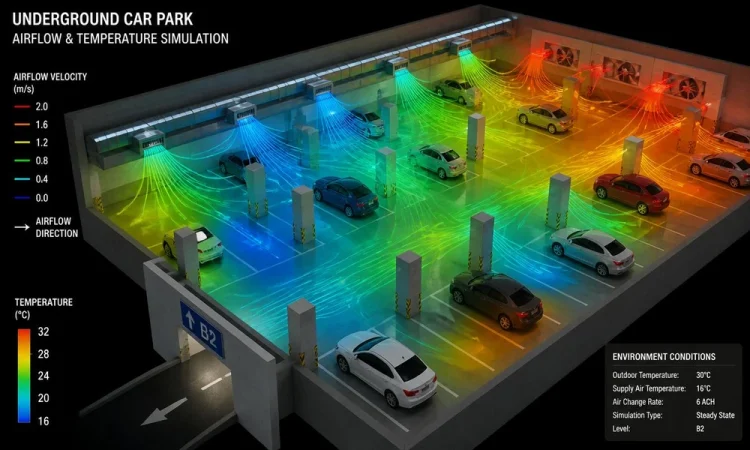
The design of modern underground and enclosed car parks presents significant challenges for fire safety and ventilation. Unlike traditional ducted systems, contemporary designs often utilise a car park jet fan system to move air and manage smoke. However, the effectiveness of these fans is not always intuitive. To ensure that these systems will actually perform as expected during an emergency, engineers rely on Computational Fluid Dynamics, specifically CFD thermal analysis. This advanced simulation technology allows designers to visualise how air, heat, and smoke will move through a specific space. Before any hardware is installed, a rigorous digital verification process must be undertaken to identify potential failures and optimise the safety of the environment for both occupants and emergency responders.
1. Accuracy of the Virtual Geometry
A CFD simulation is only as good as the data entered into it. Before proceeding with the analysis, it is vital to ensure that the 3D model of the car park is an exact digital twin of the actual or planned structure. This includes the placement of beams, columns, ramps, and even large stationary objects like parked vehicles, all of which can significantly obstruct or redirect airflow. If the model is oversimplified, the simulation may fail to identify “dead zones” where smoke could accumulate dangerously. By ensuring a high-fidelity model, the resulting CFD thermal analysis provides a much more reliable foundation for safety planning, allowing for the precise placement of fans to overcome architectural obstacles.
2. Strategic Fan Placement and Thrust
The primary role of a car park jet fan is to impart momentum to the air, creating a flow that pushes smoke towards extract points. During the planning phase, you must check that the fans are positioned in a way that creates a continuous and effective air stream. The CFD analysis should demonstrate that there is no “short-circuiting,” where air simply circles back on itself rather than moving towards the exit. Engineers must also consider the thrust of the fans; too little power and the smoke will not move, while too much can cause excessive turbulence that might actually hinder evacuation. The simulation allows for the fine-tuning of fan angles and power settings to achieve an optimal balance across the entire floor area.
3. Thermal Impact and Visibility
In a fire scenario, smoke is not the only threat; extreme heat can cause structural damage and make evacuation impossible. A comprehensive CFD thermal analysis tracks the temperature gradients throughout the car park during a simulated fire. This data is crucial for determining if the heat will stay localized or if it will spread to exit routes. Furthermore, the simulation should provide data on visibility levels. In an emergency, occupants need to be able to see exit signs and pathways. By checking the predicted smoke density and temperature at various heights, designers can ensure that the ventilation system maintains tenable conditions for a sufficient duration to allow for a safe exit.
4. Compliance with Safety Standards
Ultimately, the goal of installing a car park jet fan system is to meet or exceed mandatory fire safety codes. Different jurisdictions have specific requirements for smoke clearance rates and temperature limits. Before finalising any design, the results of the CFD analysis must be meticulously checked against these local standards. This documentation is often a required part of the building submission process. A well-executed CFD report serves as scientific proof that the proposed safety measures are effective. It provides peace of mind to building owners and regulatory bodies that the car park is engineered to handle a fire event with maximum efficiency and safety.
Conclusion
Integrating advanced simulation technology into the planning of ventilation systems is no longer optional; it is a critical component of modern engineering. By carefully checking the geometry, fan placement, thermal dynamics, and regulatory alignment, developers can ensure that their car park is as safe as possible. The synergy between a powerful car park jet fan array and a rigorous CFD thermal analysis creates a robust safety net for any building. Investing in this level of detail during the design phase saves lives, protects property, and ensures long-term compliance with evolving safety regulations.
Ensure your facility meets the highest standards of fire safety and ventilation efficiency. Our experts specialise in advanced car park jet fan integration and CFD thermal analysis for complex structures. Contact SHEVS IFT Consultants today to secure your building’s safety plan.